PRACTICAL GUIDE · PRICING
Your hourly rate has to fund the hours you cannot invoice too.
A salary divided by 2,080 hours ignores business costs, unpaid work, time off and utilization. A capacity-aware rate starts with the annual revenue requirement and divides it by hours you can realistically bill.
Core takeaway
Build the rate from your own economics, test more than one utilization scenario and convert it into project pricing with explicit scope and buffers.
1. Find the annual revenue requirement
Add target personal income to every recurring and variable business cost. Include software, insurance, equipment, professional services, payment fees and training. Add a deliberate business buffer rather than hoping it appears at year end.
2. Calculate realistic billable capacity
Remove vacation, holidays and expected non-working weeks. Estimate billable hours after sales, admin, research and internal work. Measure actual utilization over time and update the assumption.
- Working weeks per year
- Total working hours
- Non-billable operating time
- Realistic billable hours
- Low, base and stretch utilization
3. Translate the floor into offers
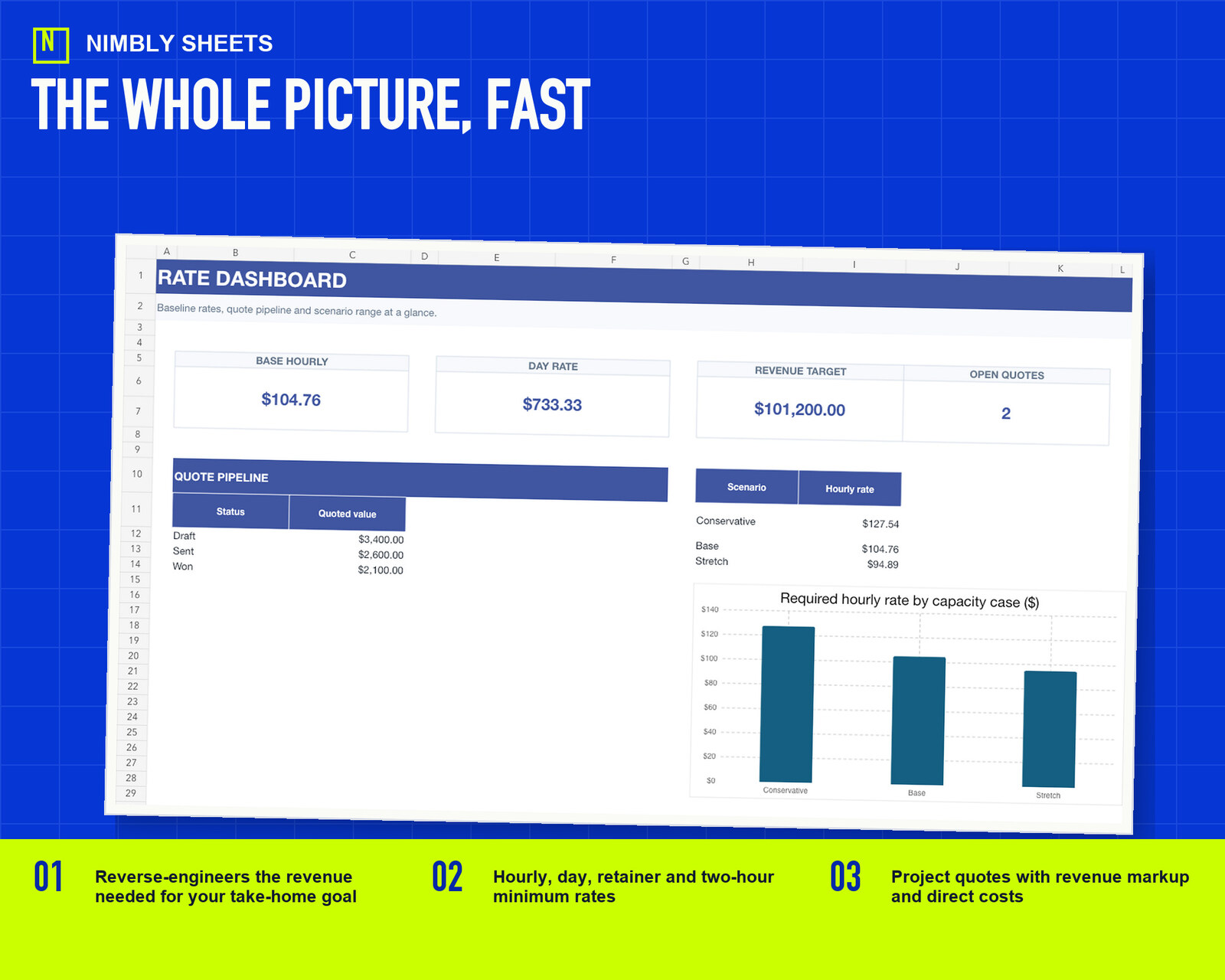
The hourly reference can be converted into day, project and retainer scenarios. Entered effort, direct costs and an uncertainty buffer change a project scenario; entered capacity, rollover and response-time assumptions change a retainer scenario.
4. Compare price, scope and margin together
If a buyer resists the quote, avoid lowering price without changing the deal. Reduce scope, extend timing, change the service level or remove risk. Recalculate after every material change.
Educational organization and planning content only. It does not replace tax, legal, accounting, financial or technical advice where applicable.
WORKFLOW CHECKLIST
The complete routine in six steps.
- 01Annualize income and business costs
- 02Remove time off
- 03Estimate billable—not total—hours
- 04Add a business buffer
- 05Model low and base utilization
- 06Check project margin before sending a quote
APPLY THE METHOD
Use a workbook that already connects the steps.
The template turns this method into editable inputs, checks and summaries with realistic example rows.
Freelance Rate Calculator
FREQUENTLY ASKED QUESTIONS
Before you begin.
Does the workbook choose a billable utilization rate?
No. Utilization is an editable assumption. The workbook compares the mathematical results of different entered percentages.
Does the workbook decide between hourly and project pricing?
No. It compares mathematical scenarios using entered scope, capacity, costs and risk assumptions; it does not recommend a commercial model.
Can I use competitor rates?
They are useful market context, but they do not reveal another business's costs, utilization or required margin.